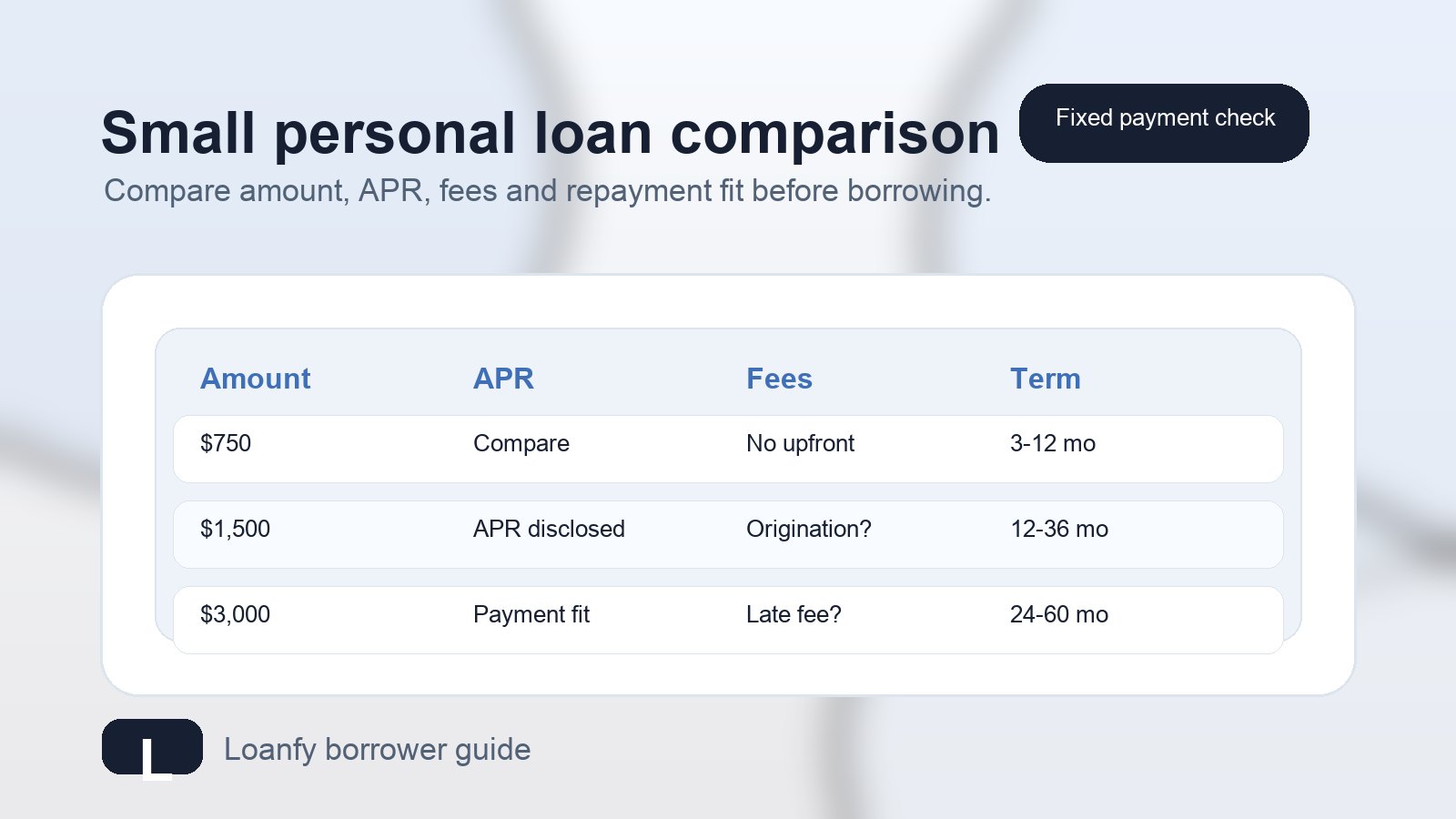
Direct answer: what are the best small personal loans?
The best small personal loans are usually the options that let you borrow only the amount you need, show the full APR and fee picture, repay in predictable installments and avoid upfront-fee or payday-style traps. For many U.S. borrowers, the best starting points are credit union small-dollar loans, small loans from a bank where you already have an account, transparent online personal loans with low minimum amounts, and reputable loan marketplaces that let you compare several lenders before applying.
Search results for this keyword are dominated by lender roundups from personal finance publishers. Forbes Advisor, Credible, WalletHub and ConsumerAffairs all use listicle formats with top picks, comparison tables, author or editor signals, methodology notes, FAQs and warnings about high-cost alternatives. The useful gap is not another unverified ranking of lenders. The useful gap is a borrower-first comparison of small-loan routes, because a $500 need, a $1,500 repair and a $4,000 medical bill do not all fit the same product.
Loanfy is not a direct lender and does not guarantee approval. It is a borrower-intent site that can help people organize the amount, purpose and timing behind a request. If you are still sorting out the product type, start with the loan options overview, then compare more specific paths such as personal loans, installment loans and bad credit loans.
Quick comparison of small personal loan options
| Option | Best fit | What to verify |
|---|---|---|
| Credit union small-dollar loan | Borrowers who can join a credit union and want a lower-cost local option | Membership rules, loan amount range, fee cap, APR and repayment term |
| Small bank loan | Borrowers with an existing checking relationship or direct deposit history | Minimum amount, autopay rules, account requirements and late fees |
| Online personal loan | Borrowers who need a fixed installment loan and can compare several lenders | APR, origination fee, minimum loan amount, term length and hard inquiry timing |
| Loan marketplace | Borrowers who want several possible matches from one comparison flow | Partner network, soft-check language, data sharing and final lender terms |
| Secured small loan | Borrowers with collateral or savings who need a lower rate than unsecured offers | Collateral risk, account hold rules, default consequences and payoff flexibility |
| Payday alternative loan | Credit union members who need a safer short-term small-dollar structure | PAL I or PAL II limits, application fee, term and membership requirement |
| 0% card or payment plan | Borrowers who can repay quickly and avoid carrying the balance past promotion | Deferred interest, late-payment trigger, payoff deadline and regular APR after promo |
7 best small personal loan options by use case
1. Credit union small-dollar loans: best first call for lower-cost borrowing
A local or federal credit union can be the best place to start if the amount is small and you can meet the membership rules. Credit unions often offer personal loans, secured loans and small-dollar alternatives that are designed around member relationships rather than pure lead volume. That matters when you need $500 to $2,000 and do not want to be pushed into borrowing more than necessary.
The National Credit Union Administration describes payday alternative loans as a credit union option with guardrails. PALs I can range from $200 to $1,000 with terms of one to six months, while PALs II can go up to $2,000 with a maximum term of 12 months. Not every credit union offers them, and membership requirements still matter, but this route is worth checking before accepting a very high-cost online offer.
2. Small bank loans: best if your bank knows your deposit history
Some banks offer small personal loans or small-dollar lines to existing customers. The advantage is context. A bank that can see regular deposits, account age and normal cash-flow patterns may be able to evaluate a small request more efficiently than a lender seeing you for the first time. The trade-off is that these products may require an active checking account, autopay or a minimum history with the bank.
Compare the bank offer against at least one outside option. Relationship convenience is useful, but it does not automatically mean the lowest cost. Look for the APR, origination fee, late fee, payment date flexibility and whether the bank reports on-time payments to credit bureaus.
3. Online personal loans: best for fixed payments and broader availability
Online personal loan lenders appear heavily in current small-loan SERPs because they can offer fast applications, prequalification flows and fixed repayment schedules. Roundups from Forbes Advisor and Credible emphasize lender minimums, APR ranges, credit score requirements, funding speed, fees and repayment terms. Those are the right comparison points, but borrowers should remember that published ranges are not personal offers.
This route works best when the loan minimum matches the real need. If you need $800 and the lender minimum is $5,000, the extra available credit can become a budgeting problem. Borrowing more than the bill requires may feel like breathing room, but it also increases total repayment and can make a small problem last for years.
4. Loan marketplaces: best for checking several lenders without visiting each site
A marketplace can be useful when you want to compare several possible lenders from one request. It may save time and help you spot whether you are broadly in range for a small installment loan. This is especially practical if you are comparing loan amounts around $1,000 to $5,000 and want to see whether credit profile, income or state availability limits your options.
The caution is data sharing and offer status. A marketplace estimate is not the same as final approval, and the actual lender may still verify income, identity, debt obligations and credit. Read the soft-check language before submitting, then compare the final lender disclosure before accepting anything.
5. Secured small loans: best when collateral lowers the cost
A secured small loan can make sense if you have savings, a certificate account or another acceptable form of collateral and want a lower rate than an unsecured loan. Credit unions and banks may offer share-secured or savings-secured loans that let you borrow against your own funds while building payment history.
The risk is obvious but important: collateral can be frozen or lost if you default. That makes secured loans a better fit for borrowers who have a clear repayment plan and want to preserve cash flow, not for borrowers who are already unsure they can make the payment.
6. Payday alternative loans: best credit union substitute for payday borrowing
If the need is urgent and small, a payday alternative loan from a federal credit union may be safer than a payday loan. The NCUA created PAL structures with amount, term and fee restrictions, and the rules include protections such as no rollovers. That makes PALs worth checking if you are a member of a participating credit union or can join one quickly.
Do not assume every credit union offers PALs. Ask directly about PAL I, PAL II, small-dollar emergency loans and membership timing. Also ask how quickly the loan can fund and whether the payment schedule fits your next several paychecks, not just the next one.
7. 0% cards or provider payment plans: best only when payoff is realistic
A 0% introductory credit card or a provider payment plan can be a cheaper alternative to a small personal loan if the expense qualifies and you can repay before the promotional window ends. This can fit dental bills, medical balances, appliance purchases or other fixed costs where the provider has a transparent plan.
The danger is deferred interest, missed-payment triggers and a regular APR that takes over when the promotion ends. Treat this option like a timed payoff plan, not free money. If you cannot repay on schedule, a fixed small personal loan may be easier to budget than a revolving balance.
How to choose a small personal loan
First, define "small" for your actual expense. Experian notes that some lenders may start around a few hundred dollars, but many mainstream personal loan lenders start closer to $1,000 or $2,000. If the lender minimum is far above your need, the loan may be structurally wrong even if the APR looks acceptable.
Second, compare APR instead of only monthly payment. The Consumer Financial Protection Bureau explains that APR includes the interest rate plus additional fees charged with the loan. That matters with small loans because an origination fee can take a meaningful bite out of the cash you actually receive.
Third, check whether the repayment term solves the problem or stretches it. A short term can create a painful payment; a long term can make a small expense cost more over time. For a small loan, the best term is usually the shortest payment you can comfortably afford without missing rent, utilities, food, insurance or other required bills.
Finally, compare the loan against alternatives. If the expense is urgent, the emergency loan options guide can help you separate speed from safety. If the expense is part of a larger pattern of card balances, the debt consolidation alternatives guide may be more relevant than another small loan.
This article is educational and is not financial, legal, tax or credit advice. Loan availability, final APR, fees, funding timing and approval depend on lender underwriting, borrower profile, state rules and documents provided during application.
What to avoid when shopping for a small loan
Avoid any company that guarantees approval before checking your profile or demands money before a promised loan is delivered. The Federal Trade Commission warns that advance-fee loan scams often claim they can get borrowers credit regardless of history, then ask for a processing, insurance or application fee upfront. That is a major red flag.
Also be careful with payday loans when the need is small. The CFPB describes payday loans as short-term, high-cost loans that are usually for $500 or less and commonly due on the next payday. For a typical two-week payday loan with a $15 fee per $100 borrowed, the CFPB says the APR is almost 400 percent. A product can be small and still be very expensive.
Finally, avoid confusing speed with fit. Fast funding can be useful when the expense cannot wait, but a loan that funds quickly and creates three years of strained payments is not a clean solution. Compare the payment, total repayment, fee structure and consequences of missing a payment before accepting.
FAQ
What is the best small personal loan?
The best small personal loan is the lowest-cost option that matches your real amount, repayment timeline and credit profile. For many borrowers, that means checking a credit union, bank or transparent online lender before considering higher-cost short-term products.
Can I get a small personal loan under $1,000?
Sometimes. Credit unions, community banks and certain small-dollar programs may offer loans below $1,000. Many online personal loan lenders have minimums closer to $1,000, $2,000 or higher, so verify the minimum before applying.
Are small personal loans good for bad credit?
They can be useful if the APR, fees and payment are manageable, but damaged credit usually means fewer options and higher costs. Compare credit union alternatives, secured options and bad-credit lenders carefully before accepting a high-cost loan.
What is the safest small loan?
The safest small loan is usually transparent, amortizing, affordable and issued by a known bank, credit union or licensed lender. It should disclose APR and fees before you commit and should not require an upfront payment for a promised approval.
Should I use a small loan marketplace?
A marketplace can help you compare several potential lenders, but it may share your information with partners and may not show every available lender. Use it as one research step, then verify the final lender terms directly.
Sources used
- Forbes Advisor: Best Small Personal Loans
- Credible: Best Small Personal Loans
- WalletHub: Best Small Personal Loans
- Experian: smallest personal loan guidance
- Consumer Financial Protection Bureau: interest rate vs. APR
- National Credit Union Administration: payday alternative loans
- Federal Trade Commission: advance-fee loan scams
- Consumer Financial Protection Bureau: payday loans